


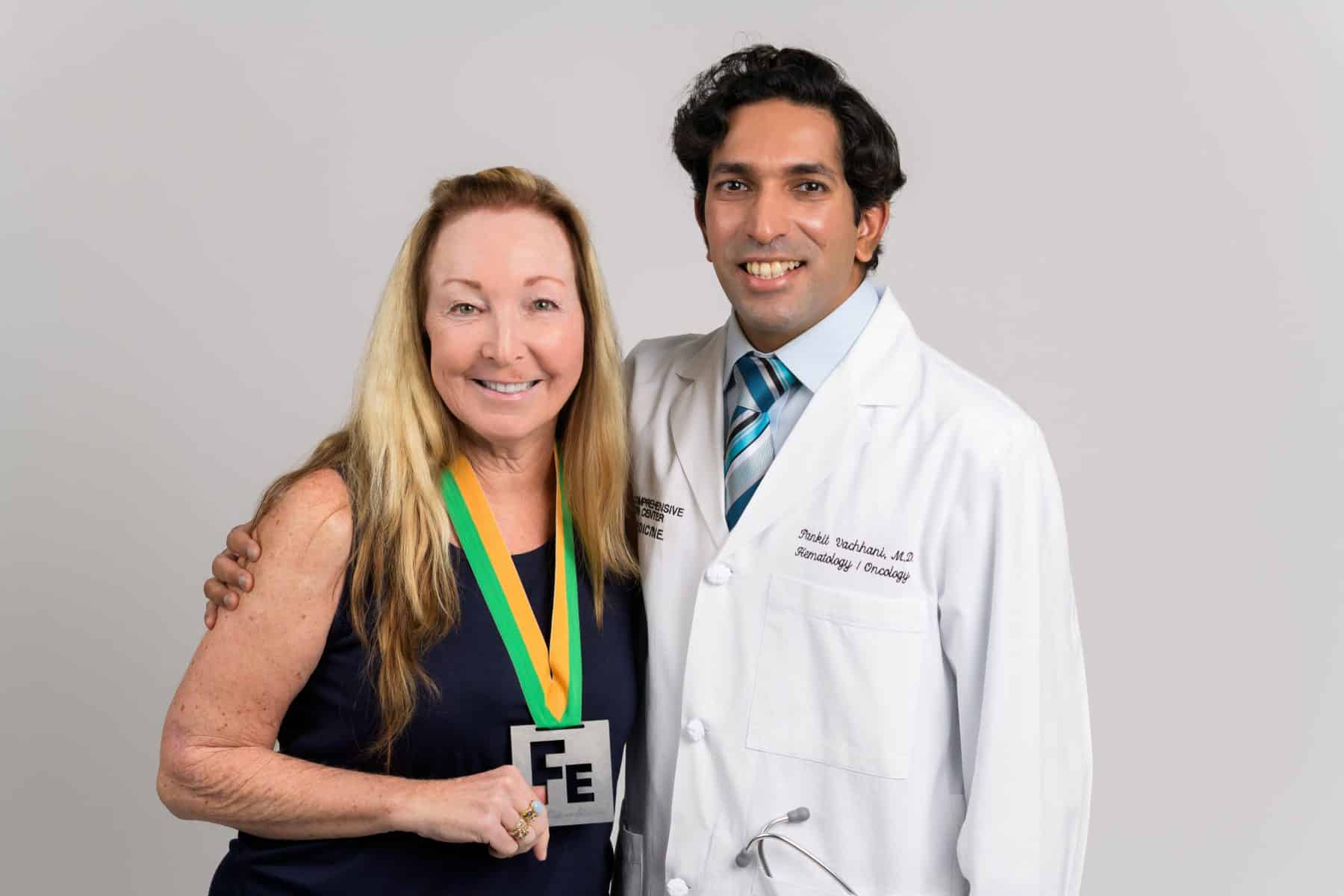
Kimberly Pacheco
You don’t spend more than 30 years in the United States Air Force, as Kimberly Pacheco did, without having a bit of toughness and determination to you. But in 2019, Pacheco began to lose that fighting spirit because of a mysterious illness that was debilitating her.
While serving at Tyndall Air Force Base near Panama City, Fla., Pacheco started struggling with a wide variety of issues, including nausea, skin lesions, muscle and bone pain, headaches, dizziness and fatigue. Physicians in the area could not pinpoint the problem, and Pacheco was finally forced to take an honorable discharge from the service.
“It was getting to the point where it was hard for me to do anything,” Pacheco says. “I was on a whole bunch of medicines, but I just kept getting sicker and sicker.”
Finally, Pacheco received a recommendation to visit UAB for evaluation. Before long, she was diagnosed with mastocytosis, a rare cancerous condition that affects only 1-in-100,000 people. Pacheco began receiving treatment through the UAB Mastocytosis Clinic, a designated Center of Excellence by the American Initiative in Mast Cell Diseases Network.
“We tried a few medications, but she didn’t really respond well,” says clinic director Pankit Vachhani, M.D., an assistant professor of medicine in the UAB Division of Hematology and Oncology. “So in 2023, she agreed to go on a study we were conducting called APEX, where we gave her high doses of an oral TKI (tyrosine kinase inhibitors).
“After that, she improved remarkably. Now her pain issues are nearly gone, the skin lesions are much improved, and her energy level is back. Nearly every symptom has improved, and she has a new vigor in her life. She’s back to living like she used to, with really no concerning symptoms.”
In fact, the results for Pacheco and other patients in this clinical trial have been so promising that Vachhani says the drug is expected to receive FDA approval next year.
Pacheco says she technically isn’t cured, since cancer cells remain in her bone marrow. She continues to take three pills a day and make the nearly 10-hour round-trip from Panama City to UAB once a month for blood work.
But considering what her life was like just two years ago, Pacheco says she has no complaints. And while she certainly credits the medication itself with prompting her recovery, she says it was Vachhani and UAB that pointed her in the right direction.
“My trust in Dr. Vachhani and the team at UAB is unquestionable. I can’t say enough good things about them,” Pacheco says. “Everybody there truly pays attention to the patients. They listened to me and understood the difficulties I was having, and figured out what was wrong.
“Where I had been dying, now I’m living. It’s pretty much a miracle to me. I’m alive because of UAB. The most important thing for me through all this was getting to the right people. And UAB has the right people.”