


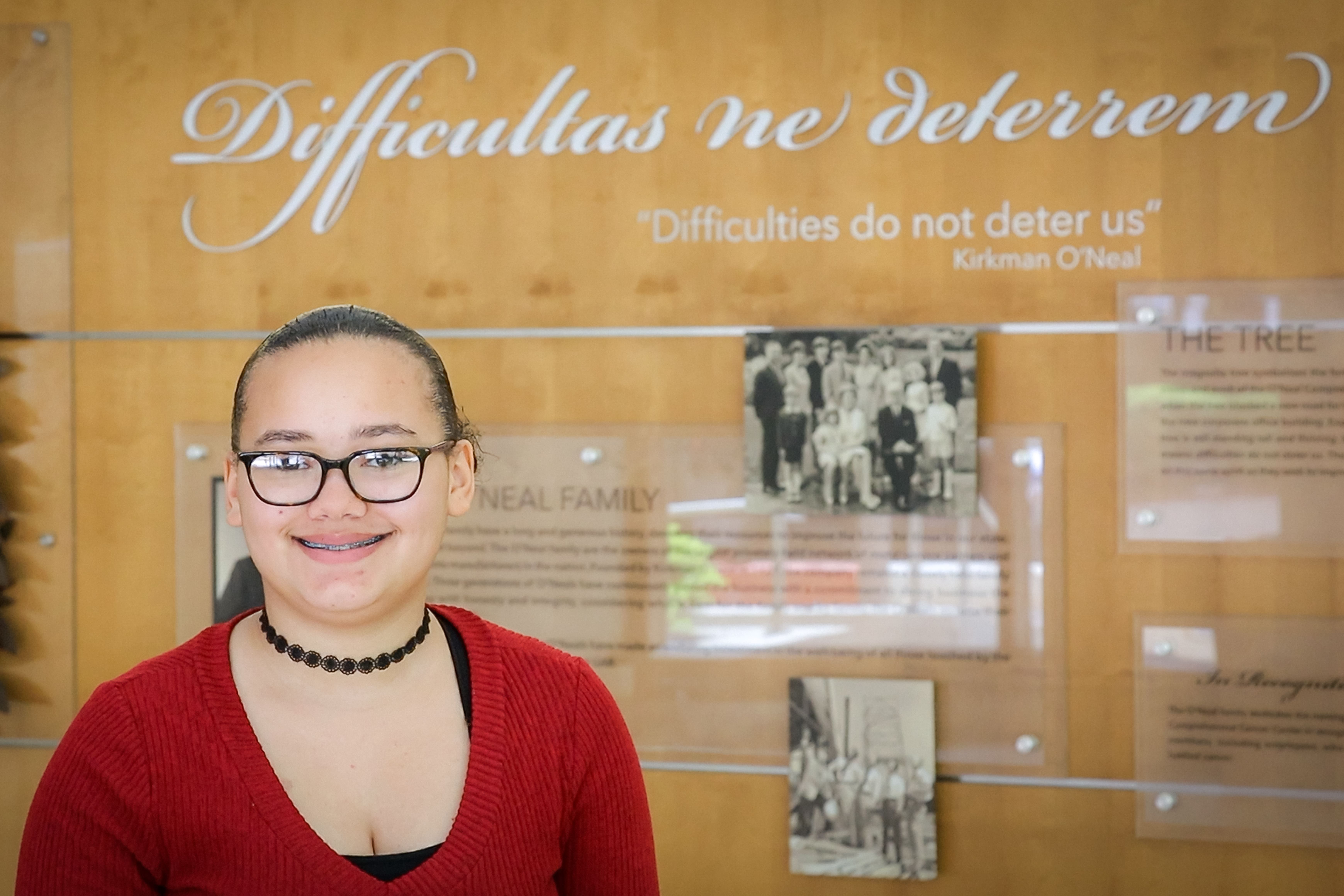
Gabryella “Gabby” McCraw
Iron Strong Awards 2026
Physician: Ana Xavier, M.D., and Julie Wolfson, M.D.
Cancer type: B-cell lymphoblastic leukemia
In addition to benefiting patients, clinical trials often advance understanding of a disease or condition.
Gabryella “Gabby” McCraw was just eight years old when she was diagnosed with B-lymphoblastic leukemia at Children’s of Alabama. She had remarkable results from a clinical trial that helped her become cancer-free without needing a bone marrow transplant. And she contributed to improved care for children like herself in the future.
During her initial screenings, doctors discovered that McCraw had a genetic marker that placed her in a high-risk category. At that time, the standard of care for such patients was chemotherapy, followed by a bone marrow transplant.

Instead, McCraw’s aunt and legal guardian, Sheneka Frieson, was presented with the option of having her niece take part in a clinical trial involving an experimental medication called blinatumomab. This would require McCraw to wear a backpack-like device that continually injected the medication over almost a month. They decided that the potential benefits would be worth any inconvenience.
“The doctors were very thorough in breaking down what that journey would look like,” Frieson said. “The great thing about the doctors at Children’s is that they are able to meet the children on their level and carefully explain everything to them and answer their questions. That gives them some comfort. There was never a time when we didn’t feel supported.”

Avoiding a bone marrow transplant
McCraw received the blinatumomab infusion for almost a month at a time on two separate occasions. Afterward, she was found to be cancer-free, eliminating the need for a bone marrow transplant. She continued to receive therapy through the trial for another two years.
McCraw was not alone with her results. The clinical trial proved to be so successful with numerous patients that it finished two years ahead of schedule. The findings were published in The New England Journal of Medicine in 2024, and blinatumomab became the standard of care for this type of childhood cancer.
“Gabby represents the best-case scenario for our pediatric patients participating in a clinical trial,” said UAB pediatric medical oncologist Ana Xavier, M.D. “Thanks to Gabby and thousands of other patients who participated in this study, we know that this drug is highly efficient, so now we use it for all children under the same circumstances.”
“We strive to enroll all patients in these types of studies because of examples like this one,” Dr. Xavier added. “We have an excellent survivor rate for our patients with leukemia thanks to the participation of patients in clinical trials. There is no way to do pediatric oncology without clinical research.”
McCraw is now 14 years old, and Frieson says she is living life just like any other teenager.
“I’m proud of Gabryella for being tenacious,” Frieson said. “And I’m very thankful for the team she came in contact with at Children’s, from the front desk to the doctors and nurses. I always tried to let Gabby know that this was a team effort. She might be the one who had to take the medicine and the treatment, but she was not alone. We all had to walk through that fire together. I’m so proud that she is able to live a healthy life now.”